Chris Preimesberger46


Q2: From a recent Wrike survey: More than half of U.S. companies say a work from home policy would seriously harm productivity. Depends on the use case, I know--but what's your take?
Sean Broderick
A2: @uplandsoftware has a remote first culture with limited offices in the US and EMEA. I think mindsets will change during the current crisis and people can see that employees work just as hard at home as they do in the office.
Dan Lahl
Q2 HOGWASH! My team is spread all over the world, from Israel to China and India. The management of companies have to get on board with the new normal of remote workforces...
Tom Randall
A2. This is likely based on a bad perception of what 'work' is. Work is a process, not something inherently tied to a place. As remote work becomes a norm over the next few months, we'll see focus on results/outcomes, not how many hours you spend in an office #eWEEKchat
Seth Elliott
A2: For us we have been operating as a distributed team across multiple locations from the start: Bulgaria, Berlin, London and Denver. We've also had a very liberal work from home policy and this has all driven more productivity for us personally
@usmcjost
depends on the company, culture, and role. WFH is very prevalent in our company and we have highly collaborative and productive teams. For the most part, I think many "knowledge worker" roles can easily WFH.
Mike Jumper
A2: Strongly the opposite. We use @ApacheGuacamole for essentially everything, and now rely on it. It is true that some businesses cannot avoid requiring physical presence. For all others, it doesn’t make sense to knowingly turn away from flexibility.
Seth Elliott
A2: Having said that we obviously (given our product) have an intense OKR culture in our DNA. We see that it's highly situational in regards to whether WFH fits into both company culture and strategy-execution management capabilities
@usmcjost
Also keep in mind these are not "Normal" WFH times with kids being out of school, sports, etc. So there are many more distractions.
Dan Lahl
A2 glad this panel is dispelling the notion of work only happening in a corporate or satellite office...
Kurt Schrader
We've had a mostly remote team at @clubhouse for several years now and we haven't seen a drop in productivity (the opposite in fact). There's definitely a lot work to be done to make sure that you have the right processes in place though.
@usmcjost
Personally I have seen a dramatic increase of video use, getting to know co-workers, their families, pets, etc. We are reconnecting humanity back into the workplace.
Andrew Filev
A2: That was actually a survey of 1,000+ workers, and half believed their companies weren't ready to go remote. With the proper tools in place, orgs can make it happen. Here's the survey info: https://www.wrike.com/blog/are-employees-ready-to-.... #eWEEKchat
Ready or Not: Are Employees Ready to Go Remote? | Wrike
There's been an increase in remote work due to the novel coronavirus, but are employees ready to go remote? Get insight on the statistics by reading more.
There's been an increase in remote work due to the novel coronavirus, but are employees ready to go remote? Get insight on the statistics by reading more.
Tom Randall
@usmcjost absolutely agree - this is something that will require structural change so that labour not traditionally seen as a part of the economy (childcare, etc.) definitely ought to be. Several hundreds years late!
Seth Elliott
A2: I'd add anecdotally a guess that companies fearing WFH productivity erosion are likely to be organizations in which 'Agency' for each employee skews lower
Peter Burris
A2. For rote activities with no physical component, no effect on productivity. For an activity that changes in response to time or context, having folks proximate can be better. But, of course, most offices are poorly managed and run!
Sean Broderick
A2: Working from home with the kids in the house has a huge impact on productivity :) Maybe that's what the Wrike study was highlighting!
Tom Randall
A2. Productivity could increase with less meetings! This pandemic has shown that many ‘would-be’ meetings can actually be resolved through IM, audio/video chat, or email. Employees can now rightfully ask: do we actually need a meeting for xyz? #eWEEKchat
Seth Elliott
@mtjmpr A2: I think this is a strong point - the infrastructure in place to create efficacy for WFH is critical
Molly Presley
A2: WFH will become more productive as data moves to the cloud. Much of the sensor data lands in a data center today. Once policies to move that data are put in place, research from home will be easier. And likely that shift to cloud will be permanent.
Dave Vellante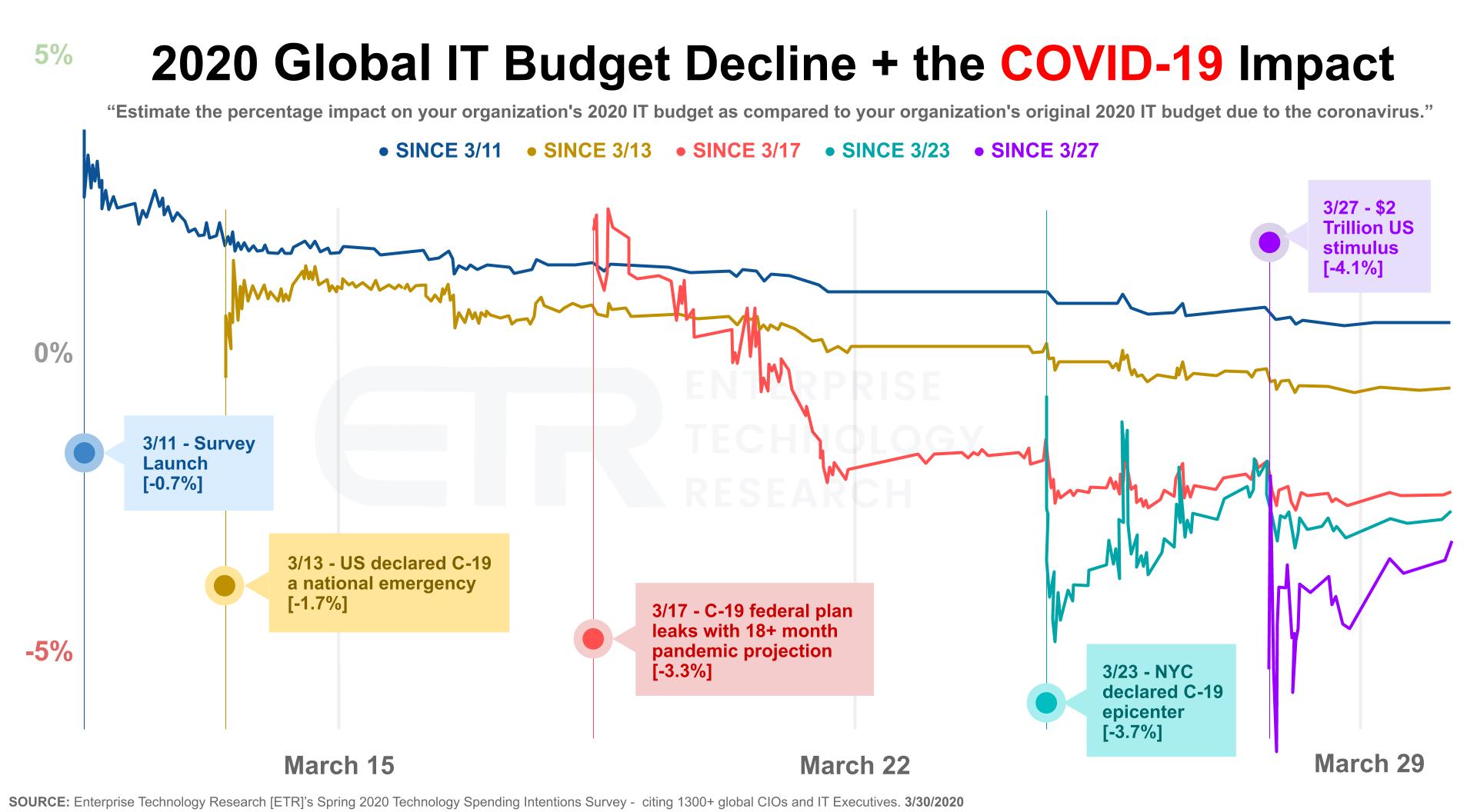
Breaking Analysis: CIOs Now Expect Budget Declines of 4% in 2020 - Wikibon Research
The latest survey data shows CIOs expect budget declines of four percent (4%) in 2020.
The latest survey data shows CIOs expect budget declines of four percent (4%) in 2020.
Kurt Schrader
@kurt You need to make sure that you're over-communicating everything and have feedback loops in place for everyone. Right now we're seeing what it looks like if everyone is just thrown into the fire without thinking their processes through.
Dan Lahl
A2 I've asked 2 development colleagues about development productivity during wfh at SAP. Both report they are ahead on most of their project timelines (both run 500+ person units at SAP)
Seth Elliott
A2: using the tools we'll all talk about - and having in place a method like OKRs that is not 'command & control' and that empowers workers while enabling progress evaluation massively helps this process
@usmcjost
There is a ton of "Real Estate" budget that can to optimizing operations if WFH can really transform certain business models.
Molly Presley
A2: Qumulo has always had Agile dev teams face to face. They have moved seamlessly to WFH and met their biweekly releases as planned. No slow down and possibly an acceleration in productivity reported.
Sean Broderick
@kurt Love that sentiment. Over-communicating in this period is crucial
Peter Burris
@danlahl A2. Good use of Zoom.
Jose Pastor
A2: We are hearing that productivity is still strong from many of our customers. Work has changed. For now a shared mission and good tools are a winning combination. #eWEEKchat
Jeff Miller
I've been working remotely since 2007, and have worked for remote-first companies. If the culture and infrastructure support it, remote-work is at least as productive as in-office, in my experience.
Molly Presley
@JosePastor We have seen the same, particularly in markets service media data to consumers, researchers working on COVID. Activity in those environments have spiked while others are more or less status quo.
Chris Preimesberger
@dvellante Hi Dave! Thanks for joining
Mike Jumper
@thomaserandall I think you're right regarding companies viewing work as being tied to a place, but I'm surprised that any would continue to hold this view in light of the current pandemic.
Tom Randall
@mtjmpr Agreed. This is a paradigm shift in how we understand work.