eweekchat

Trends in Collaboration Tools
JOIN US: This is a chat-based conversation about what tools we're using in working from home and in teams and whether we're more (or less) efficient. We'll have expert guest hosts!
   6 years ago
#eweekchatTrends in Data OrchestrationJOIN US: This is a chat-based conversation about what we're seeing in the organization of all that data we're collecting. Data orchestration--using Kubernetes or other platforms--is a key topic right about now. We'll have expert guest hosts!
   6 years ago
#eweekchatTrends in Mobile Apps, DevicesJOIN US: This is a chat-based conversation about what new mobile devices and apps are out there to help us work from home during the pandemic. Samsung's new 5G phone is among the pioneers. We'll have expert guest hosts!
Chris Preimesberger
Q2: From a recent Wrike survey: More than half of U.S. companies say a work from home policy would seriously harm productivity. Depends on the use case, I know--but what's your take?
Sean Broderick
A2: @uplandsoftware has a remote first culture with limited offices in the US and EMEA. I think mindsets will change during the current crisis and people can see that employees work just as hard at home as they do in the office.
Dan Lahl
Q2 HOGWASH! My team is spread all over the world, from Israel to China and India. The management of companies have to get on board with the new normal of remote workforces...
Tom Randall
A2. This is likely based on a bad perception of what 'work' is. Work is a process, not something inherently tied to a place. As remote work becomes a norm over the next few months, we'll see focus on results/outcomes, not how many hours you spend in an office #eWEEKchat
Seth Elliott
A2: For us we have been operating as a distributed team across multiple locations from the start: Bulgaria, Berlin, London and Denver. We've also had a very liberal work from home policy and this has all driven more productivity for us personally
@usmcjost
depends on the company, culture, and role. WFH is very prevalent in our company and we have highly collaborative and productive teams. For the most part, I think many "knowledge worker" roles can easily WFH.
Mike Jumper
A2: Strongly the opposite. We use @ApacheGuacamole for essentially everything, and now rely on it. It is true that some businesses cannot avoid requiring physical presence. For all others, it doesn’t make sense to knowingly turn away from flexibility.
Seth Elliott
A2: Having said that we obviously (given our product) have an intense OKR culture in our DNA. We see that it's highly situational in regards to whether WFH fits into both company culture and strategy-execution management capabilities
Dave Vellante
I'm seeing mixed data on that Chris...on the one hand, it's true many companies are scrambling to put in #WFH infrastructure & are not prepared. On the other hand I see customers rapidly getting better and ramping up productivity. #less #Travel
@usmcjost
Also keep in mind these are not "Normal" WFH times with kids being out of school, sports, etc. So there are many more distractions.
Dan Lahl
A2 glad this panel is dispelling the notion of work only happening in a corporate or satellite office...
Kurt Schrader
We've had a mostly remote team at @clubhouse for several years now and we haven't seen a drop in productivity (the opposite in fact). There's definitely a lot work to be done to make sure that you have the right processes in place though.
@usmcjost
Personally I have seen a dramatic increase of video use, getting to know co-workers, their families, pets, etc. We are reconnecting humanity back into the workplace.
Andrew Filev

A2: That was actually a survey of 1,000+ workers, and half believed their companies weren't ready to go remote. With the proper tools in place, orgs can make it happen. Here's the survey info: https://www.wrike.com/blog/are-employees-ready-to-.... #eWEEKchat
https://www.wrike.com/blog/are-employees-ready-to-go-remote/
Ready or Not: Are Employees Ready to Go Remote? | Wrike
There's been an increase in remote work due to the novel coronavirus, but are employees ready to go remote? Get insight on the statistics by reading more.
Tom Randall
@usmcjost absolutely agree - this is something that will require structural change so that labour not traditionally seen as a part of the economy (childcare, etc.) definitely ought to be. Several hundreds years late!
Seth Elliott
A2: I'd add anecdotally a guess that companies fearing WFH productivity erosion are likely to be organizations in which 'Agency' for each employee skews lower
Peter Burris
A2. For rote activities with no physical component, no effect on productivity. For an activity that changes in response to time or context, having folks proximate can be better. But, of course, most offices are poorly managed and run!
Dan Lahl
@usmcjost so lots of videos of sap employees bringing their kids and pets to work right now. Humanizes the situation :-)
Sean Broderick
A2: Working from home with the kids in the house has a huge impact on productivity :) Maybe that's what the Wrike study was highlighting!
Tom Randall
A2. Productivity could increase with less meetings! This pandemic has shown that many ‘would-be’ meetings can actually be resolved through IM, audio/video chat, or email. Employees can now rightfully ask: do we actually need a meeting for xyz? #eWEEKchat
Seth Elliott
@mtjmpr A2: I think this is a strong point - the infrastructure in place to create efficacy for WFH is critical
Molly Presley
A2: WFH will become more productive as data moves to the cloud. Much of the sensor data lands in a data center today. Once policies to move that data are put in place, research from home will be easier. And likely that shift to cloud will be permanent.
Dave Vellante
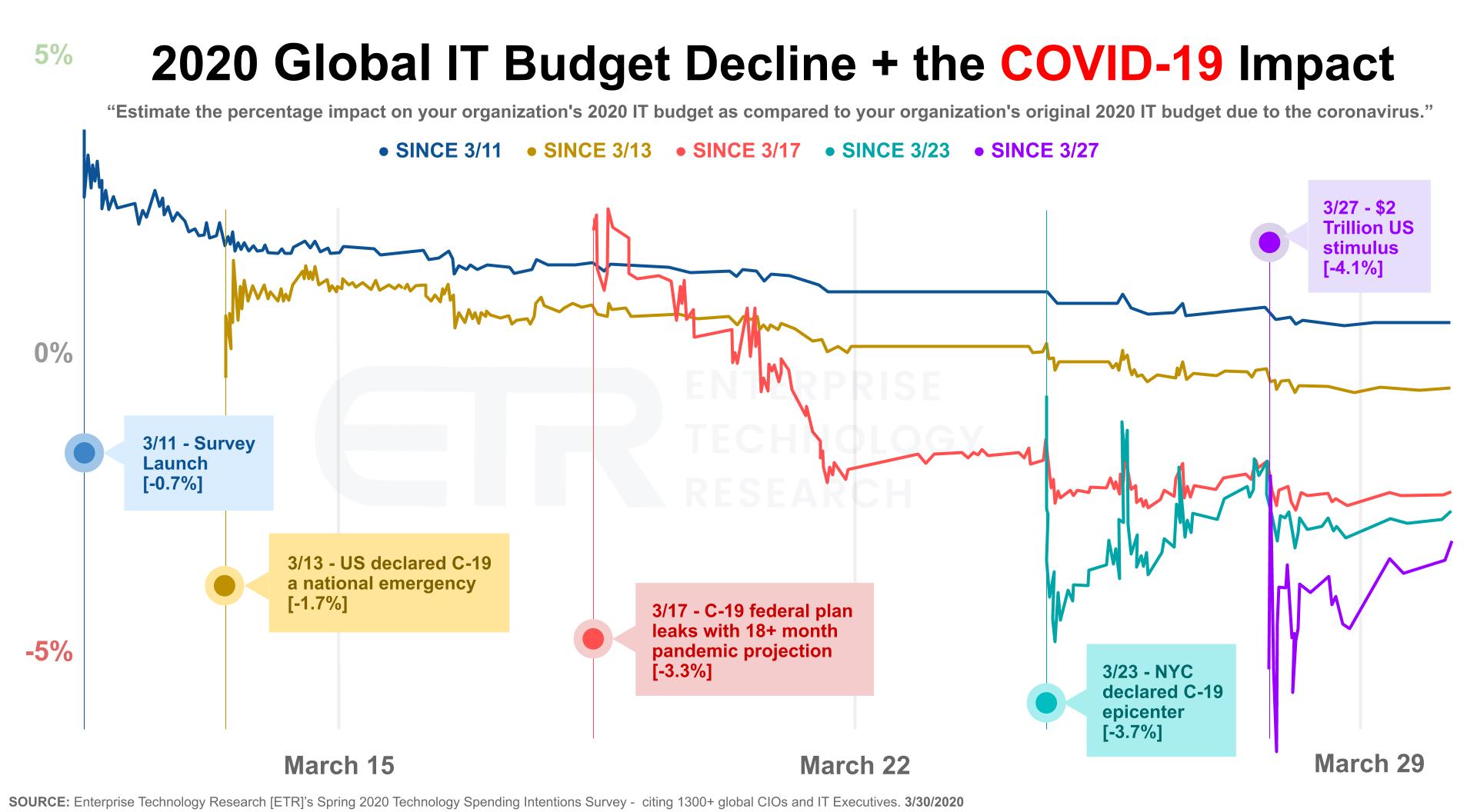
21% of respondents in a recent @etrnews survey indicate they're actually planning to spend more in 2020 as a result of #COVID19 - the offset to the precipitous declines is all related to #WFH infrastructure (not just video but networking, security, VDI, etc.).
Dave Vellante
https://wikibon.com/breaking-analysis-cios-now-exp...
https://wikibon.com/breaking-analysis-cios-now-expect-budgets-to-decline-4-in-2020/
Breaking Analysis: CIOs Now Expect Budget Declines of 4% in 2020 - Wikibon Research
The latest survey data shows CIOs expect budget declines of four percent (4%) in 2020.
Kurt Schrader
@kurt You need to make sure that you're over-communicating everything and have feedback loops in place for everyone. Right now we're seeing what it looks like if everyone is just thrown into the fire without thinking their processes through.
Dan Lahl
A2 I've asked 2 development colleagues about development productivity during wfh at SAP. Both report they are ahead on most of their project timelines (both run 500+ person units at SAP)
Seth Elliott
A2: using the tools we'll all talk about - and having in place a method like OKRs that is not 'command & control' and that empowers workers while enabling progress evaluation massively helps this process
@usmcjost
There is a ton of "Real Estate" budget that can to optimizing operations if WFH can really transform certain business models.
Dan Lahl
@kurt agree - we are having Zoom video meetings just to keep things human. For me, I have a Monday noon meeting and a Friday breakfast meeting with my team - no work, just talk - video mandatory
Molly Presley
A2: Qumulo has always had Agile dev teams face to face. They have moved seamlessly to WFH and met their biweekly releases as planned. No slow down and possibly an acceleration in productivity reported.
Sean Broderick
@kurt Love that sentiment. Over-communicating in this period is crucial
Peter Burris
@danlahl A2. Good use of Zoom.
Jose Pastor
A2: We are hearing that productivity is still strong from many of our customers. Work has changed. For now a shared mission and good tools are a winning combination. #eWEEKchat
Jeff Miller
I've been working remotely since 2007, and have worked for remote-first companies. If the culture and infrastructure support it, remote-work is at least as productive as in-office, in my experience.
@usmcjost
@danlahl Yep Zoom lunches, happy hours, just saying hi. We may be more connected now than ever?
Dan Lahl
A2 @danlahl Gartner is expecting database sales to retract up to 10%, so the spending decrease for CIOs is real...
Molly Presley
@JosePastor We have seen the same, particularly in markets service media data to consumers, researchers working on COVID. Activity in those environments have spiked while others are more or less status quo.
Chris Preimesberger
@dvellante Hi Dave! Thanks for joining
Dan Lahl
@usmcjost Erik, I found out I have 2 people on my team that are Orchid experts - they are coaching me!!!
@usmcjost
@danlahl This hits home my dad was and Orchid grower for many years!
Mike Jumper
@thomaserandall I think you're right regarding companies viewing work as being tied to a place, but I'm surprised that any would continue to hold this view in light of the current pandemic.
Tom Randall
@mtjmpr Agreed. This is a paradigm shift in how we understand work.
Chris Preimesberger
I invited Ryan Naraine to join us today, hope he does!
Chris Preimesberger
Q2 coming up ...
Chris Preimesberger
An analyst I respect greatly, Ryan Naraine of Intel--and a former eWEEK security reporter--said the other day that Zoom has its security process in a much better place now, and that people shouldn't just abandon it off the top.
Andrew Filev
Absolutely agreed.
Tom Randall
That's fair - Zoom is the best-of-breed at w. conferencing. End users should be aware of ensuring good security habits, though: protect meetings with a password, don't share links on open media channels, and retain host control of the screen share! #eWEEKchat

(edited)

Jose Pastor
+1 on good security habits. For meetings with sensitive topics we also suggest that hosts use the waiting room feature to ensure that they know who is in the meeting #eWEEKchat
Don Simmons
SANS had a webcast that reviewed ZOOM and recommended security settings.
Chris Preimesberger
Reference https://www.eweek.com/enterprise-apps/how-zoom-is-...
https://www.eweek.com/enterprise-apps/how-zoom-is-attempting-to-fix-security-missteps
How Zoom Is Attempting to Fix Security 'Missteps'
eWEEK NEWS ANALYSIS: Thanks largely to the COVID-19 pandemic, Zoom's number of worldwide users has surpassed the 200 million mark, a spectacular rise after market analyst Apptopia reported it served a mere 12.9 million users on Jan. 1.
Chris Preimesberger
Q1: The fast-rising use of videoconference tools such as Zoom have revealed some major security issues that hadn't been anticipated. Zoom CEO Eric Yuan said he is working hard to fix them, but do you trust your own videoconferencing app right now?
Tom Randall
A1. Securing w. conferencing tools is important to prevent shared information being compromised – especially in industries such as government and healthcare. However, tools can only do so much – I also advise instilling good security habits into end users. #eWEEKchat
Molly Presley
A1: At Qumulo, we keep a close eye on who is in any given meeting and make sure updates are regularly done by employees. But, yes, we do trust it and have relied on Zoom heavily for years.

(edited)

Dan Lahl
Q1 - yes and no... At SAP we have internally deployed skype and MSFT Teams, and we are using some Zoom. Concerned about Zoom, less so about teams and skype
Seth Elliott
A1: Well we use Zoom as a paid tool. We've moved a little more towards using the password protected features. On the whole, I'd say we 'trust' Zoom - certainly we continue to use it. If trust also includes connectivity we are seeing some degradtion there.
@usmcjost
A1, I think for the most part some of these "Security" issues are inherent with all video collab tools, and some issues are items they need to fix. Kudos to the teams who are scaling and keeping these platforms operational right now
Andrew Filev
A1: @zoom_us has definitely raised some red flags lately, and they seem to be reacting in stride. It's not surprising that a crisis of this magnitude reveals weaknesses in otherwise sound solutions. #eWEEKchat
Sean Broderick
A1: We use a mixture of Zoom and MS Teams, GoToWebinar for external webinars. For each of them they are secure for the purpose they are used
Kelly Barnett, PMP
A1 my client uses Webex exclusively
Seth Elliott
A1: Also we do use Slack's video feature for internal communication and we place a lot of trust there.
Jose Pastor
A1. Not all videoconferencing apps are created equal. Users need to to educate themselves on how to keep their meetings under control and secure.
Tom Randall
Zoom has needed to massively scale in the past month or so. The engineering is quite a feat. I appreciate their transparency and 90 day feature freeze to focus on their security issues. #eWEEKchat
Molly Presley
A1: @sethaelliott Slack video is a great internal tool at Qumulo as well! Great point, secure and dynamic.

(edited)

Dan Lahl
A1 we also use sharepoint as well for MSFT documents and we have our own product we use extensively, called SAP Jam. One problem with all of these tools is they are horizontal and not specific to anyone's job roles
Andrew Filev
A1: I trust them to a certain extent. They need to do their part to ensure a secure solution, but I also think orgs need to educate employees on video conferencing security protocols. Make sure everyone has "waiting room" enabled or passwords required.
Peter Burris
A1. Zoom is fine for what it does, but collaboration is much more than looking at a digital simulacrum of a colleague. If looking at a colleague isn't a problem, don't use it.

(edited)

Sean Broderick
A1: We are living in the generation of Zoomers, for internal works chats @uplandsoftware it works great but we want some extra security for customer facing webinars
Kurt Schrader
A1: We use Zoom with the privacy settings turned up, so for our purposes it works well. My daughter's school, on the other hand, doesn't appropriately know how to adjust the settings, so I don't trust it there at all (and they're moving off of it).
Dan Lahl
A1 is using Webex anymore? That seems to have lost its mojo. Too many dialog boxes just to get started...
@usmcjost
Companies using 2,3, or more solutions are going to find themselves explaining which tool when, and how to secure each tool far more often than those who have standardized or used a persona based approach. This is a consistent challenge in the UC space.
Tom Randall
A1. Zoom is the best-of-breed at w. conferencing. End users should be aware of ensuring good security habits, though: protect meetings with a password, don't share links on open media channels, and retain host control of the screen share!
Mike Jumper
A1: We use Hangouts Meet at Glyptodon. The Zoom news is concerning, and users of any software involving a man-in-the-middle style provider should be conscious of the implicit trust they are granting, including videoconferencing.
Molly Presley
@danlahl A1: No we stopped using Webex. Prefer On24 for webinars and Zoom/Slack for collaboration. These newer tools are more dynamic, easier to use, more cost effective.
@usmcjost
@danlahl people either love it or hate it.
Seth Elliott
@Molly_J_Presley we've actually been using Zoom for webinars - it's not the ideal solution but it has made some of the activities and integrations a bit easier since it's one core platform
Sean Broderick
A1: Data breaches are becoming so commonplace that peoples tolerance for them has increased. I tend to agree with Ryan from Intel. I don't see a massive shift away from Zoom domination anytime soon. Doesn't make it right
Molly Presley
@sethaelliott Our biggest concern with Zoom for webinars is that it doesn't have a private speaker room. Have you solved that?
Seth Elliott
@Molly_J_Presley ha - alas no - and it has a number of other drawbacks as well
Barry Russell
A2: Depends on the employee role, team or function I believe in terms of productivity gained, lost or flat. I have noticed an increase in productivity in certain areas and a timeliness to make meetings.